Ebook Free SQL Antipatterns: Avoiding the Pitfalls of Database Programming (Pragmatic Programmers)
So, all individuals that review SQL Antipatterns: Avoiding The Pitfalls Of Database Programming (Pragmatic Programmers) will certainly seem like doing the things by themselves. It depends on how the readers gaze and consider this book. But, frequently, it actually includes the outstanding thoughts of the book reading. It will likewise offer you the outstanding systems of creativity. Of course, it will serve you much better idea of perfections. It is why we constantly supply you the best publication that can make your life better. Currently, feel the life to obtain the remarkable means of publication success.
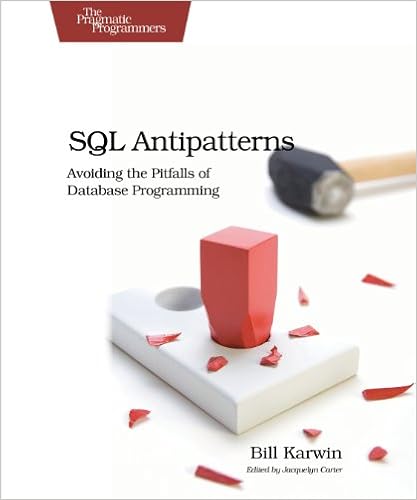
SQL Antipatterns: Avoiding the Pitfalls of Database Programming (Pragmatic Programmers)

Ebook Free SQL Antipatterns: Avoiding the Pitfalls of Database Programming (Pragmatic Programmers)
Where you could discover the SQL Antipatterns: Avoiding The Pitfalls Of Database Programming (Pragmatic Programmers) easily? Is it in guide store? Internet publication store? are you certain? Keep in mind that you will discover guide in this website. This book is very referred for you due to the fact that it provides not only the experience yet also lesson. The lessons are very beneficial to offer for you, that's not about that read this book. It has to do with this book that will give wellness for all individuals from numerous societies.
When you're a beginner visitor or the one that try to start love analysis, you can pick SQL Antipatterns: Avoiding The Pitfalls Of Database Programming (Pragmatic Programmers) as the very best option. This publication is popular among the viewers. This is just one of the factors we recommend you to try analysis this publication. Also this is not kind of publication that will certainly provide huge chance; you can get it detailed. As just what we constantly heard about finding out can be done by steps. You cannot reach the knowledge at the same time by doing whatever, it will need some procedures.
This concept is because we offer the soft file of the book. When other people bring the hard book all over, you could just hold your gadget. Saving the soft file of SQL Antipatterns: Avoiding The Pitfalls Of Database Programming (Pragmatic Programmers) in your gizmo will certainly reduce you in analysis. When you are being at home, you can also open in the computer. So, saving guide soft data in some devices are offered. It will make easier of you to discover just how the activity is going to be extremely basic because of the more advanced innovation.
You could rapidly finish them to see the page then delight in obtaining guide. Having the soft file of this book is additionally adequate. By by doing this, you may not should bring the book anywhere. You could conserve in some compatible gadgets. When you have actually made a decision to start checking out SQL Antipatterns: Avoiding The Pitfalls Of Database Programming (Pragmatic Programmers) again, you can begin it all over and whenever as quickly as well done.
Review
""This book is obviously the product of many years of practical experience with SQL databases. Each topic is covered in great depth, and the attention to detail in the book was beyond my expectations. Although it's not a beginner's book, any developer with a reasonable amount of SQL experience should find it to be a valuable reference and would be hard-pressed not to learn something new.""--Mike Naberezny, Partner at Maintainable Software; Coauthor of "Rails for PHP Developers"""Bill has written an engaging, useful, important, and unique book. Software developers will certainly benefit from reading the antipatterns and solutions described here. I immediately applied techniques from this book and improved my applications. Fantastic work!""--Frederic Daoud, Author of "Stripes: ...And Java Web Development Is Fun Again" and "Getting Started with Apache Click"
Read more
About the Author
Bill Karwin has been a software engineer for over twenty years, developing and supporting applications, libraries, and servers such as Zend Framework for PHP 5, the InterBase relational database, and the Enhydra Java application server. Throughout his career, Bill has shared his knowledge to help other programmers achieve success and productivity. Bill has answered thousands of questions, giving him a unique perspective on SQL mistakes that most commonly cause problems.
Read more
Product details
Series: Pragmatic Programmers
Paperback: 328 pages
Publisher: Pragmatic Bookshelf; 1 edition (July 5, 2010)
Language: English
ISBN-10: 1934356557
ISBN-13: 978-1934356555
Product Dimensions:
7.5 x 1 x 9.2 inches
Shipping Weight: 1.2 pounds (View shipping rates and policies)
Average Customer Review:
4.5 out of 5 stars
51 customer reviews
Amazon Best Sellers Rank:
#121,352 in Books (See Top 100 in Books)
I love this book. The chapters were broken up by anti-pattern and the format of each chapter was perfect; state the problem, state the anti-pattern solution, explain why it is not a valid solution, show how to identify when it's being used and finally present more valid alternative solutions (and explain why they're more valid).I work on a team that creates new new products for a software company. Because of its innovative nature, the team leads will often explore new development methods with much vigor and little research. And even when research is performed, there is rarely much consideration toward the database.I am kind of the "database guy" when it comes to the projects, and pick up most of those tasks. This book has given me good insight as to when an anti-pattern is being proposed and why we should consider an alternative. The appendix also has a very clean and concise layout of the rules for normalization. This comes in handy when a specific reference for your argument is required.If your development team doesn't have a "database guy" (or if you're it), I highly recommend reading this book.
Great book! I started as a database developer and then became a web developer years later. While there is a lot of basic information in this book, there are also a few clever tricks I did not know. Regardless, it is information that EVERY developer needs to know to develop the fastest, most flexible applications with minimal redundancy.It is also a fascinating read that did not take very long to digest. I read this cover-to-cover in a couple of weeks on a 25 minute train commute to work every day.Highly, highly recommended regardless of skill level with databases. It is packed with great tricks and easy to digest knowledge. If you already "knew it" like myself, you will come away knowing it better.
I found many of the anti patterns discussed to be extremely useful. I thoroughly marked up that chapter on software best practices. This book will help you assess consequences of many workarounds that may seem innocent at first.The main ideas that pervade all the chapters werelet the database do its work;don't implement its main features in software, and consequently leverage foreign keys.My only drawback is that the book wanders off sql ground a bit too easily in the final chapters.i found the discussion of Active Record to be need more justification and depth. Otherwise, it would have been better to leave it out of this book. Similarly with the PHP examples.
First half quite useful; I'm glad I read it, though it turns out I had avoided most of the antipatterns through simple common sense. A good comment about the limitations of prebuilt frameworks.The second half of the book was mostly padding; can't remember much about it, I ended up skimming, but it was more about PHP than SQL. A re-iteration of OWASP, the terrors of SQL injection, and so on. In my mind these do not have much to do with SQL per se.
I'm only page 80, but so far I love it. There are things us data guys know are sub-optimal or just plain wrong. Bill Karwin explains it so well in terms that the object guys I work with might be able to get it. A violation of first-normal form is "jay-walking" because you're avoiding the intersection (table.) I cringe when I see a self-referencing relationship. It looks so simple and elegant on paper, but it's usually the first step on a journey to a bad outcome. Bill Karwin calls this a "naive tree" and presents several alternatives. I wish I'd had the next three chapters about ten years ago when we created a persistence framework at work that used surrogate keys everywhere in a concrete to the bottom implementation of object graphs with relational intergrity turned off. If you're not a data guy or an object guy, you have no idea what that last sentence was about. If you are a data or object guy, buy the book and read it.
The only thing that prevented me from reading the book through faster was the structure - it tends to be heavy on emphasizing the anti-pattern before going deeper into the good practices and ultimately the solution. For someone with some experience with databases there is simply too much convincing why some approach won't work.That said there is valuable advice in there, I already suggested we use closure tables (one of the solutions to the chapter about tree structures in databases) in my current project to tackle too much container/content type relations.I can recommend the "SQL Antipatterns" to anyone who wishes to extend his bag of tricks when dealing with relational databases, I largely enjoyed it!
Once you've mastered, or at least think you have, the basics of relational databases, this is a good book to pick up. Karwin goes over the most common pitfalls of SQL database design and programming. As one that frequently has to work with someone else's database design I see these pitfalls over and over again. Some are obvious to any DB programmer worth his salt, some others, not so obvious and still others the subject of religious wars. I didn't agree with all of Karwin's suggestions or even what he identified as antipatterns, but that's fine. I've been using SQL since the 80's and I still learned something from this book. In our office, most of the programmers have to know enough SQL to make simple queries or at least to be able to decipher what some code is doing. This book will help eliminate the part that normally follows "to know enough", that is the "to be dangerous" part.
I liked it very much.The tips are very useful.Especially for developers who came to databases through modern web-frameworks (though not all tips are easy to be implied in that case).Every chapter shows wrong way, then several alternatives (from the worse to the best).
SQL Antipatterns: Avoiding the Pitfalls of Database Programming (Pragmatic Programmers) PDF
SQL Antipatterns: Avoiding the Pitfalls of Database Programming (Pragmatic Programmers) EPub
SQL Antipatterns: Avoiding the Pitfalls of Database Programming (Pragmatic Programmers) Doc
SQL Antipatterns: Avoiding the Pitfalls of Database Programming (Pragmatic Programmers) iBooks
SQL Antipatterns: Avoiding the Pitfalls of Database Programming (Pragmatic Programmers) rtf
SQL Antipatterns: Avoiding the Pitfalls of Database Programming (Pragmatic Programmers) Mobipocket
SQL Antipatterns: Avoiding the Pitfalls of Database Programming (Pragmatic Programmers) Kindle


